Blog

How to assess nature projects: a framework for investing in nature with confidence

Restore through Nature

Policy & Compliance

Climate Leadership

Blog

How to assess nature projects: a framework for investing in nature with confidence

Restore through Nature

Policy & Compliance

Climate Leadership

Hill climb
Hill climb
Katie Pownall

Philanthropic Projects Manager

6 min read
Hill climb

The Real Cost of Nature Loss

Nature is moving out of the margins into the financial mainstream. As businesses worldwide wake up to the material risks of biodiversity loss and ecosystem degradation, a question emerges: how do you know if a nature project will actually deliver what it promises? Without trust, well-intentioned investments risk becoming greenwashing liabilities, and critical funding fails to reach the projects that need it most.

The numbers tell us an unambiguous story: more than half of global GDP depends on nature. But, for every dollar spent protecting nature, thirty dollars are spent degrading it. In 2023 alone, $7.3 trillion flowed into activities actively destroying nature. 

The urgency to act now couldn't be clearer. 2024 was the warmest year on record, and we've just experienced the first three consecutive years exceeding 1.5°C above pre-industrial levels. Ocean acidification is pushing coral reefs past thermal tipping points while some tropical forests are shifting from carbon sinks to carbon sources due to extreme climate stress. Global processes such as the UN Convention on Biological Diversity COP16 and UN Framework Convention on Climate Change COP30 have reinforced that climate stability and nature recovery are inseparable but the window for preventing irreversible ecosystem collapse is closing.

Beyond environmental impacts, nature loss ranks among the top five global risks to current and future investments. Consequences are already materialising:

  • Supply chains are fracturing as nature-dependent inputs become unreliable, driving up costs and reducing supply security.

  • Physical assets face mounting exposure as ecosystem degradation amplifies flooding, heat and wildfires, increasing operational downtime and damage costs.

  • Regulatory pressure is intensifying with frameworks like the Taskforce on Nature-related Financial Disclosures (TNFD), the Corporate Sustainability Reporting Directive (CSRD) and national biodiversity targets creating disclosure requirements and potential market access barriers.

But the flip side is equally compelling. Companies that invest strategically in high-quality nature projects are gaining tangible advantages: reduced operational risk, stronger stakeholder trust, enhanced brand differentiation, lower insurance premiums and readiness for emerging regulations, to name just a few.

Nature is moving out of the margins into the financial mainstream. As businesses worldwide wake up to the material risks of biodiversity loss and ecosystem degradation, a question emerges: how do you know if a nature project will actually deliver what it promises? Without trust, well-intentioned investments risk becoming greenwashing liabilities, and critical funding fails to reach the projects that need it most.

The numbers tell us an unambiguous story: more than half of global GDP depends on nature. But, for every dollar spent protecting nature, thirty dollars are spent degrading it. In 2023 alone, $7.3 trillion flowed into activities actively destroying nature. 

The urgency to act now couldn't be clearer. 2024 was the warmest year on record, and we've just experienced the first three consecutive years exceeding 1.5°C above pre-industrial levels. Ocean acidification is pushing coral reefs past thermal tipping points while some tropical forests are shifting from carbon sinks to carbon sources due to extreme climate stress. Global processes such as the UN Convention on Biological Diversity COP16 and UN Framework Convention on Climate Change COP30 have reinforced that climate stability and nature recovery are inseparable but the window for preventing irreversible ecosystem collapse is closing.

Beyond environmental impacts, nature loss ranks among the top five global risks to current and future investments. Consequences are already materialising:

  • Supply chains are fracturing as nature-dependent inputs become unreliable, driving up costs and reducing supply security.

  • Physical assets face mounting exposure as ecosystem degradation amplifies flooding, heat and wildfires, increasing operational downtime and damage costs.

  • Regulatory pressure is intensifying with frameworks like the Taskforce on Nature-related Financial Disclosures (TNFD), the Corporate Sustainability Reporting Directive (CSRD) and national biodiversity targets creating disclosure requirements and potential market access barriers.

But the flip side is equally compelling. Companies that invest strategically in high-quality nature projects are gaining tangible advantages: reduced operational risk, stronger stakeholder trust, enhanced brand differentiation, lower insurance premiums and readiness for emerging regulations, to name just a few.

Why Quality Matters More Than Ever

As businesses’ awareness grows, so does their risk of getting it wrong. The nature project market is inherently difficult to navigate. Two projects with identical goals can deliver vastly different outcomes depending on site conditions, community engagement or management plans. This variation has led to us defining three key challenges for businesses:

  • Inconsistent project quality means that well-intended investments can fail to deliver promised outcomes. Ecological restoration unfolds over decades and is shaped by climatic, political and social conditions. A reforestation project in a fire-prone landscape without adequate risk management can see years of progress disappear overnight. Likewise, a restoration initiative with poor site selection may never achieve the biodiversity gains it claims.

  • Lack of standardization prevents meaningful comparison between projects. Unlike carbon, where integrity frameworks are maturing, nature outcomes are complex and context-dependent. Global frameworks such as the Convention on Biological Diversity, the IUCN Global Standard for Nature-based Solutions, and the UN Environment Programme Decade on Ecosystem Restoration provide important guidance but they do not offer a standardised system for comparing project proposals pre-implementation.

  • Greenwashing risks emerge when projects overstate benefits, rely on optimistic baselines or make social co-benefit claims without documentation. With regulators cracking down (e.g., the EU now restricts generic environmental claims and prohibits “climate-neutral” assertions based solely on offsetting), unsubstantiated nature commitments are becoming legal liabilities.

As businesses’ awareness grows, so does their risk of getting it wrong. The nature project market is inherently difficult to navigate. Two projects with identical goals can deliver vastly different outcomes depending on site conditions, community engagement or management plans. This variation has led to us defining three key challenges for businesses:

  • Inconsistent project quality means that well-intended investments can fail to deliver promised outcomes. Ecological restoration unfolds over decades and is shaped by climatic, political and social conditions. A reforestation project in a fire-prone landscape without adequate risk management can see years of progress disappear overnight. Likewise, a restoration initiative with poor site selection may never achieve the biodiversity gains it claims.

  • Lack of standardization prevents meaningful comparison between projects. Unlike carbon, where integrity frameworks are maturing, nature outcomes are complex and context-dependent. Global frameworks such as the Convention on Biological Diversity, the IUCN Global Standard for Nature-based Solutions, and the UN Environment Programme Decade on Ecosystem Restoration provide important guidance but they do not offer a standardised system for comparing project proposals pre-implementation.

  • Greenwashing risks emerge when projects overstate benefits, rely on optimistic baselines or make social co-benefit claims without documentation. With regulators cracking down (e.g., the EU now restricts generic environmental claims and prohibits “climate-neutral” assertions based solely on offsetting), unsubstantiated nature commitments are becoming legal liabilities.

Ecologi’s Nature Projects Assessment Framework

In response to growing demand for credible investment pathways, Ecologi developed the Nature Projects Assessment Framework (NPAF). The objective is simple: provide a standardised, science-based benchmark to evaluate whether a nature project is likely to deliver durable ecological and social outcomes over time, before funding is committed. 

Rather than focusing narrowly on headline metrics, such as hectares restored or trees planted, the NPAF looks at the broader foundations of project integrity - our four pillars of biodiversity, socioeconomic impacts, ecosystem services and governance:

  • Biodiversity – The variety and health of species, habitats and ecosystems and their resilience to pressures.

  • Socioeconomic Impacts – The contributions to equitable human well-being, livelihoods and sustainable development.

  • Ecosystem Services – The benefits that ecosystems provide to people through their regulating, supporting, provisioning and cultural functions.

  • Governance – The institutional systems, capacities and processes that enable effective and inclusive project management.

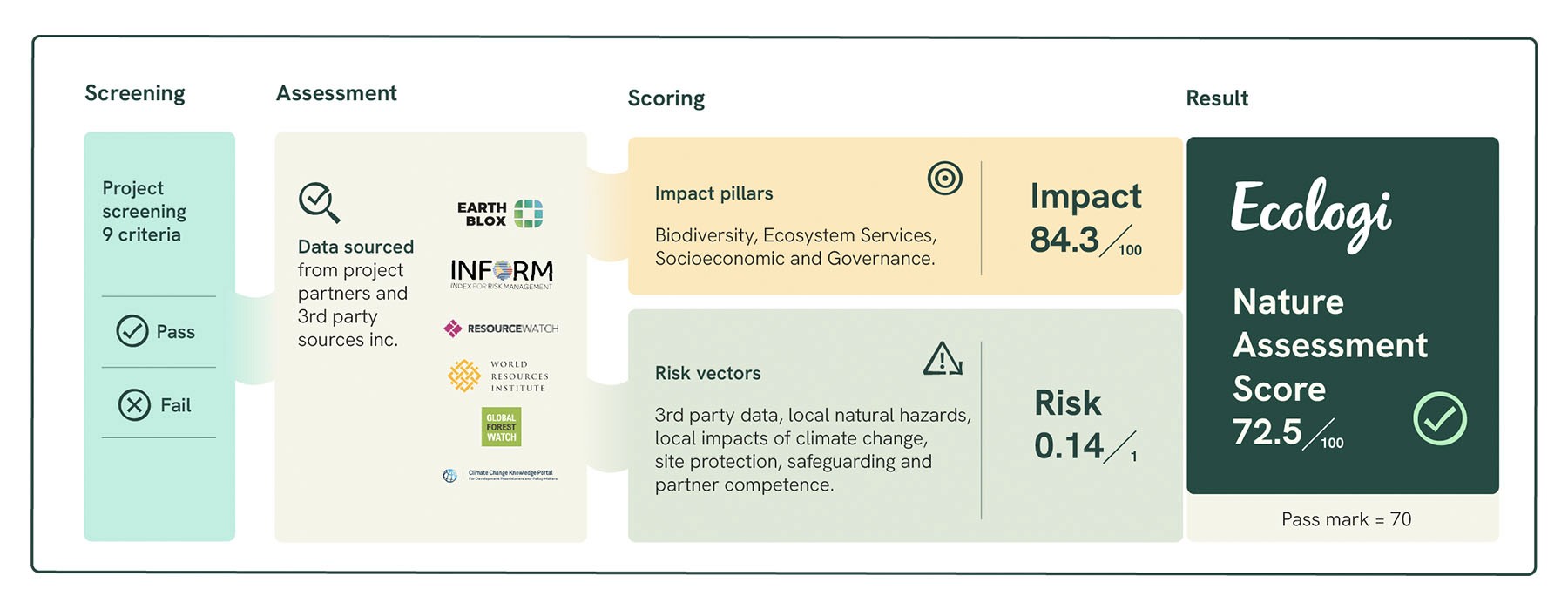
For each pillar, projects are scored against several indicators supported by qualitative and quantitative metrics. These scores are then weighted and combined to produce a final score out of 100.

We also assess risk across six dimensions: 

  • Third-Party Inputs – Measures broader country-level exposure to systemic hazards such as civil unrest, war or governance weaknesses.

  • Local Natural Hazards – Assesses exposure to environmental hazards including earthquakes, floods, tropical cyclones, tsunamis, droughts and epidemics.

  • Local Impacts of Climate Change – Examines climate-driven risks specific to the project site, including extreme heat days, precipitation anomalies, landslides, coral bleaching and disease. 

  • Site Protection – Evaluates risks related to land tenure, extractive pressures, tourism, pollution, invasive species and pest or disease outbreaks.

  • Safeguarding – Captures risks related to social responsibility and ethical practice, including forced evictions, undermining local employment, discrimination and inadequate pay.

  • Partner Competence – Assesses the project proponent’s capacity to deliver, including relevant experience in the project type or local ecosystem, absence of corruption or illegal activity, and existence of an exit strategy. 

Calculating the Nature Assessment Score

Risks within a partner's control, like safeguarding and competence, are weighted more heavily than contextual factors beyond their influence These weighted risks are then combined to produce a risk score out of 1.

The combined Impact pillars score is then multiplied by 1 minus the risk score to give an overall Nature Assessment Score.

To qualify for Ecologi's portfolio, nature projects must achieve a minimum overall score of 70. This threshold ensures projects demonstrate sufficient evidence of sound design, feasible outcomes and appropriate risk management across all dimensions.
What evidence do we use?

We draw on multiple data sources and analytical tools:

  • Project documentation and third-party audits

  • Historical baseline analysis and counterfactual scenarios

  • Remote sensing and satellite imagery (using platforms like EarthBlox to track vegetation health, land-use change and ecosystem condition)

  • Globally recognized risk indices (e.g., INFORM Risk Index, World Bank CMIP6 climate projections)

  • Field surveys and stakeholder interviews

This allows us to evaluate what projects claim to deliver and understand their realistic capacity to achieve their goals.

In response to growing demand for credible investment pathways, Ecologi developed the Nature Projects Assessment Framework (NPAF). The objective is simple: provide a standardised, science-based benchmark to evaluate whether a nature project is likely to deliver durable ecological and social outcomes over time, before funding is committed. 

Rather than focusing narrowly on headline metrics, such as hectares restored or trees planted, the NPAF looks at the broader foundations of project integrity - our four pillars of biodiversity, socioeconomic impacts, ecosystem services and governance:

  • Biodiversity – The variety and health of species, habitats and ecosystems and their resilience to pressures.

  • Socioeconomic Impacts – The contributions to equitable human well-being, livelihoods and sustainable development.

  • Ecosystem Services – The benefits that ecosystems provide to people through their regulating, supporting, provisioning and cultural functions.

  • Governance – The institutional systems, capacities and processes that enable effective and inclusive project management.

For each pillar, projects are scored against several indicators supported by qualitative and quantitative metrics. These scores are then weighted and combined to produce a final score out of 100.

We also assess risk across six dimensions: 

  • Third-Party Inputs – Measures broader country-level exposure to systemic hazards such as civil unrest, war or governance weaknesses.

  • Local Natural Hazards – Assesses exposure to environmental hazards including earthquakes, floods, tropical cyclones, tsunamis, droughts and epidemics.

  • Local Impacts of Climate Change – Examines climate-driven risks specific to the project site, including extreme heat days, precipitation anomalies, landslides, coral bleaching and disease. 

  • Site Protection – Evaluates risks related to land tenure, extractive pressures, tourism, pollution, invasive species and pest or disease outbreaks.

  • Safeguarding – Captures risks related to social responsibility and ethical practice, including forced evictions, undermining local employment, discrimination and inadequate pay.

  • Partner Competence – Assesses the project proponent’s capacity to deliver, including relevant experience in the project type or local ecosystem, absence of corruption or illegal activity, and existence of an exit strategy. 

Calculating the Nature Assessment Score

Risks within a partner's control, like safeguarding and competence, are weighted more heavily than contextual factors beyond their influence These weighted risks are then combined to produce a risk score out of 1.

The combined Impact pillars score is then multiplied by 1 minus the risk score to give an overall Nature Assessment Score.

To qualify for Ecologi's portfolio, nature projects must achieve a minimum overall score of 70. This threshold ensures projects demonstrate sufficient evidence of sound design, feasible outcomes and appropriate risk management across all dimensions.

What evidence do we use?

We draw on multiple data sources and analytical tools:

  • Project documentation and third-party audits

  • Historical baseline analysis and counterfactual scenarios

  • Remote sensing and satellite imagery (using platforms like EarthBlox to track vegetation health, land-use change and ecosystem condition)

  • Globally recognized risk indices (e.g., INFORM Risk Index, World Bank CMIP6 climate projections)

  • Field surveys and stakeholder interviews

This allows us to evaluate what projects claim to deliver and understand their realistic capacity to achieve their goals.

Download the Nature Projects Assessment Framework

Video Explainer

Watch our summary video below where an Ecologi expert explains what the Nature Projects Assessment Framework is, why it's important and how to get started.

Watch our summary video below where an Ecologi expert explains what the Nature Projects Assessment Framework is, why it's important and how to get started.

Investing in Nature is No Longer Optional for Business

Whether you're responding to investor pressure, preparing for disclosure requirements or building a nature strategy, the message is the same: nature investment needs to be transparent and backed by evidence.

Restoration done well delivers meaningful, lasting benefits for both nature and the communities that depend on it. The path forward is about recognizing that business priorities and nature-positive action are increasingly inseparable. Companies that approach nature action as a core element of risk management and long-term resilience are building a competitive advantage. But navigating this landscape requires expertise. 

At Ecologi, we've built a tool to separate signal from noise: a comprehensive and standardised assessment process, based on industry best practice. The NPAF ensures that when you invest in nature, you're backing projects with credibility and accountability.

Ready to strengthen your nature investment strategy? Download our full whitepaper, Nature Projects Assessment Framework: A new benchmark for evaluating nature-based restoration, to explore how our assessment framework is raising standards across the market.

Looking to apply this in your business?

Our team can help you build a credible nature investment strategy, grounded in science and aligned to your wider climate goals.

Speak to our experts.

Whether you're responding to investor pressure, preparing for disclosure requirements or building a nature strategy, the message is the same: nature investment needs to be transparent and backed by evidence.

Restoration done well delivers meaningful, lasting benefits for both nature and the communities that depend on it. The path forward is about recognizing that business priorities and nature-positive action are increasingly inseparable. Companies that approach nature action as a core element of risk management and long-term resilience are building a competitive advantage. But navigating this landscape requires expertise. 

At Ecologi, we've built a tool to separate signal from noise: a comprehensive and standardised assessment process, based on industry best practice. The NPAF ensures that when you invest in nature, you're backing projects with credibility and accountability.

Ready to strengthen your nature investment strategy? Download our full whitepaper, Nature Projects Assessment Framework: A new benchmark for evaluating nature-based restoration, to explore how our assessment framework is raising standards across the market.

Looking to apply this in your business?

Our team can help you build a credible nature investment strategy, grounded in science and aligned to your wider climate goals.

Speak to our experts.

Is your business ready
to take climate action?

If this article has inspired your business to start its climate journey, talk to our team today.

Is your business ready
to take climate action?

If this article has inspired your business to start its climate journey, talk to our team today.

Is your business ready
to take climate action?

If this article has inspired your business to start its climate journey, talk to our team today.